
The Reserve Bank of India has kept the key short term lending rate (repo rate) unchanged at 7.25%.

'India is an equity market with a breadth and depth of companies to invest in.'

Governor Raghuram Rajan lowered the benchmark repurchase rate to 7.75 per cent from 8 per cent, the first reduction since May 2013.

The broader markets declined with mid-caps and small-caps falling nearly 0.3% on the BSE.

In its scheme of things, tackling inflation now comes ahead of ensuring growth in the world's sixth largest economy, points out Tamal Bandyopadhyay.

The profitability of industry is under stress and needs to be addressed by encouraging investments in the supply side infrastructure.

Reserve Bank of India governor Bimal Jalan said on Monday there was no urgency to review the central bank's stance on the bank rate as announced in its October credit policy statement.\n\n

The MPC headed by RBI Governor Urjit Patel said that the recent excise duty cut by the government on petrol and diesel will help contain inflation.

While the economy seems to be on a firm growth path, the fight against inflation is not over yet. Shaktikanta Das seems to be in no hurry. After playing well through a five-year Test match, he doesn't want to get out hit wicket, observes Tamal Bandyopadhyay.

In comparison to other asset classes, globally, gold rallied significantly after many years to deliver 18.4 per cent returns in 2019.

The International Monetary Fund (IMF) on Tuesday lowered India's economic growth projection for the current fiscal to 5.9 per cent from 6.1 per cent earlier. Yet India will continue to be the fastest-growing economy in the world. In its annual World Economic Outlook, IMF also lowered the forecast for 2024-25 fiscal (April 2024 to March 2025) to 6.3 per cent from the 6.8 per cent it had predicted in January this year. The growth rate of 5.9 per cent in the 2023-24 fiscal compares to an estimated 6.8 per cent in the previous year.

Pressure has been mounting on the Reserve Bank of India to cut interest rates in the wake of declining retail inflation and the need to fuel growth momentum. However, the RBI will have to do a tightrope walk as globally interest rates are inching upwards.

The Indian equity market is likely to remain under pressure and rangebound over the next few months. This comes as global central banks, led by the US Federal Reserve look at a possibility of hiking rates aggressively to tame inflation. Back home, the Reserve Bank of India, too, remains data dependent in its endeavour to keep inflation in check and pursue an aggressive monetary policy stance.

Rajan will be closely working with the RBI governor and the four deputy governors to gain familiarity with the central bank's stance on various issues.

State Bank of India's chairman O P Bhatt on Monday said that interest rates are likely to go up in the coming months if the Reserve Bank of India (RBI) tightens its monetary stance.

'In the case of corporate credit, especially to AAA borrowers, lenders will have to take a fresh look at pricing.'

The Reserve Bank of India (RBI) on Friday kept the key repo rate unchanged at 4 per cent in view of rising inflation and faint signs of economic growth amid the gradual lifting of coronavirus related countrywide lockdown.
An action on the rate front is unlikely to figure in Rajan's plan for the moment.

'We have seen something do very well when the times are good but maybe not as well when the times are bad.'

GDP growth of 7.7 per cent in the first half of this fiscal has "left sceptics gasping and woefully behind the curve", an RBI article said on Wednesday. It also stressed the buildup in the growth momentum is likely to be sustained. The article on the state of the economy published in the Reserve Bank's December Bulletin on Wednesday also said CPI-based retail inflation is expected to ease to 4.6 per cent in the first three quarters of 2024-25 from 5.6 per cent in November.

The central bank had revised its inflation forecast significantly downward in the last policy

All BSE sectoral indices ended in the red, with oil and gas, bankex, capital goods and finance falling up to 3.04 per cent.

Banks in India are expected to cut lending rates by up to 50 basis points by September as there is sufficient liquidity in the system.

RBI awaits fiscal stance, inflation to cool off to decide on rates.
The Reserve Bank of India kept interest rates unchanged at 8.0 percent on Tuesday as widely expected, staying focused on containing inflation while adopting a more dovish tone in response to the government's call for help to revive economic growth.

In the Sensex pack, Hero MotoCorp, IndusInd Bank, Bajaj Auto, Maruti and M&M were the top gainers, spurting up to 2.66 per cent.

Striking a different note from its peers, US brokerage Bank of America Securities has maintained that the Reserve Bank will leave rates unchanged next week, recognising growth-focused and capex-driven fiscal expansion, which though poses huge price pressure and interest rate risks later. The RBI's rate setting panel Monetary Policy Committee (MPC) will begin its deliberations next Monday and announce the policy moves on Wednesday (February 9) in the backdrop of a massive spike in bond yields post the Budget. Almost all major central banks are in the process of hiking rates to tame inflation.

Fitch Ratings on Thursday raised its forecast for India's economic growth to 7 per cent for the next fiscal year starting April 1 on the back of strong domestic demand and sustained level of business and consumer confidence. With a stronger-than-expected 8.4 per cent growth in gross domestic product (GDP) during the third quarter (October-December) of the current fiscal year, Fitch saw the Indian economy expanding 7.8 per cent in 2023-24 financial year (April 2023 to March 2024), marginally higher than the government's estimate of 7.6 per cent.

'In addition, we have geopolitics and politics and all the other things that will affect commodity prices.'
The Reserve Bank has told the International Monetary Fund (IMF) that the objective of frequent interventions in the forex market is to curb excessive volatility, dismissing the Fund's rationale for reclassifying India's exchange rate regime. The IMF, following the Article IV consultation with the Indian authorities, reclassified the status of the exchange rate regime to "stabilised arrangement" from "floating" for period between December 2022 to October 2023. India's Executive Director at IMF K V Subramanian and Senior Advisors Sanjay Kumar Hansda and Anand Singh questioned the selection period adopted by the Fund for analysis and also reclassification of the country's exchange rate regime.

Foreign investors pulled out Rs 4,285 crore from Indian equities in the first three trading days of the month driven by apprehensions ahead of the third-quarter earnings season and high valuations of domestic stocks. This came following an investment of Rs 15,446 crore in the entire December, data with the depositories showed.
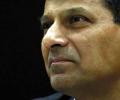
he reason behind the cut in policy rate seems to be a slowing economy

With inflation under control, the Monetary Policy Committee's (MPC's) job is to support growth because the economy had recovered well from the lows in the initial months of the pandemic, according to the panel's members, who met in the first week of this month. The minutes of the meeting show the Reserve Bank of India (RBI) governor in his statement said: "Given the sharp moderation in inflation along with a stable near-term outlook, monetary policy needs to continue with the accommodative stance to ensure that the recovery gains greater traction and becomes broad-based." Ashima Goyal, external member of the MPC, said: "The current macroeconomic configuration and its expected future evolution imply there is space for the MPC to continue to support the revival of the economy with inflation remaining in the target band."

Experts said a future rate cut would depend on the inflation.

The index could be vulnerable to a bigger fall given the present market dynamics.
With retail inflation witnessing significant uptick in May, the Reserve Bank of India (RBI) is likely to maintain status quo in its August monetary policy review, according to a report. According to the SBI's research report- Ecowrap, inflation may remain elevated in the coming months due to several global and domestic factors. "We expect a status-quo in August. We believe RBI would still try to find a marriage of convenience of regulatory and developmental measures and monetary policy in August policy," the research report said on Wednesday.
.jpg)
Food and fuel inflation in India have remained high for several years, the paper said, adding to durably reduce the current high inflation, the monetary policy stance needs to remain tight for a considerable length of time.
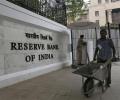
Growth remains weak, inflation is within 2-6% range, rate cut would help recoup forex reserves

Market breadth depicted gains with 1,476 advances over 1,403 declines on the BSE. 140 stocks remained unchanged.

Retail inflation measured by the consumer price index has risen sharply across food and non-food constituents, including services, keeping inflation expectations high, the Reserve Bank of India said in its Second Quarter Review of Monetary Policy 2013-14.
